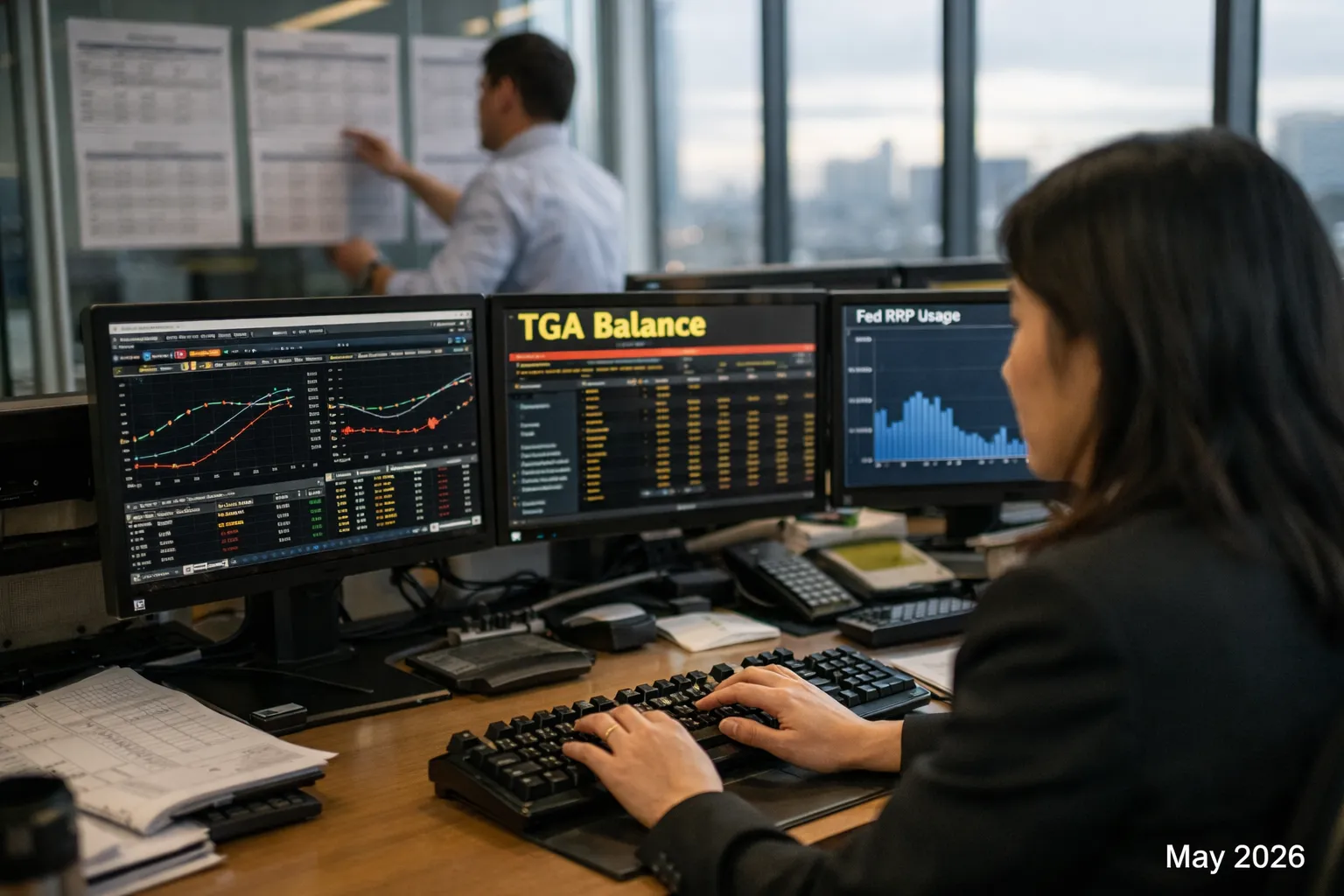
Overview
Short‑dated USD funding dynamics remain a primary driver of intraday spot moves and 1‑month (and shorter) forward-point volatility in August 2026. This update revisits the transmission chain from Treasury cash operations (TGA swings) through the Federal Reserve’s overnight reverse repo (RRP) facility into FX swap and spot markets, and adds fresh evidence, practice changes and protective tactics that traders should use right now.
Background: why this still matters
The basic plumbing has not changed: the Treasury General Account (TGA) at the Federal Reserve is the government’s cash account; large inflows or outflows shift system dollar liquidity. The RRP facility remains the principal non‑bank overnight parking place for excess cash. When the Treasury withdraws cash and RRP usage simultaneously retreats, the marginal availability of USD to dealers and banks tightens and that scarcity is priced in FX swaps and short forwards.
That calendar dependence—coupon, principal and tax settlement dates, and large refunding windows—continues to create predictable periods of elevated short‑dated funding stress. What has evolved since mid‑2026 are the market responses and some operational adaptations by market makers, both of which matter to execution and hedging strategies.
Recent developments and market context (June–August 2026)
- Higher frequency of front‑end repricing: Since late Q2 2026, dealers and electronic liquidity providers report more frequent intraday repricing of 1W–1M forward points around settlement windows. This is visible in higher tick‑to‑tick dispersion on EBS/Refinitiv feeds during Asia–London overlap.
- RRP and bill issuance dynamics: The New York Fed’s RRP book continues to act as an overflow; however, mid‑2026 saw shorter-lived spikes in RRP usage followed by sharper drops as Treasury bill auctions and coupon settlements clustered, producing faster swings into bank funding channels than in early 2026.
- Regional stress pockets: Asia session funding squeezes remain pronounced for CNH and JPY funding paths because regional banks pre‑fund USD ahead of European settlement windows. USD/JPY and USD/HKD front‑end basis moves have been the most visible symptoms for FX traders.
- Execution behaviour changed: Market‑making desks have implemented stricter inventory limits and automated dynamic spread widening during expected TGA drawdowns. That has increased bid‑offer widths but reduced outlier fills compared with earlier in the year.
Data and evidence — what to watch in real time
Use these public and market sources to build a live picture:
- TGA movements: Daily and weekly Treasury statements (US Treasury website) show scheduled and realized swings. Traders are increasingly using the Bloomberg TGA ticker (commonly USGTGA) or API pulls from the Treasury’s daily statement feed to build event calendars.
- Fed RRP uptake: The New York Fed publishes daily RRP volume and counterparty counts—sharp intraday declines in RRP around a coupon date have preceded front‑end basis widening in recent months.
- SOFR vs unsecured rates: Track SOFR, SOFR‑OIS and unsecured rates (e.g., broad money market quotes). Divergence between secured and unsecured rates signals which funding channels are under strain.
- FX swap curve (1W–3M): Live 1W–1M basis levels and slope via interdealer venues (ICAP/TP ICAP, EBS, Refinitiv) reveal when dollar funding is being repriced at the margin.
- Spot liquidity metrics: Real‑time bid‑offer and depth data in the Asia session (EBS/FXall/APIs) provide immediate evidence of thinning liquidity ahead of funding events.
Fresh examples from mid‑2026
Two representative patterns observed across June–July 2026 are useful for traders:
- Pre‑coupon squeeze and rapid unwind: In multiple mid‑month coupon windows, dealers widened 1W and 2W forward points sharply in the Asia morning before London opened, reflecting pre‑funding demand from European banks. Once US settlement flows started to reenter the system late in the New York day, spreads retraced substantially within a few hours—creating both tradeable intraday ranges and tail‑risk traps for directionally large positions.
- RRP cliff‑downs coincide with localized spot gaps: On days where RRP usage fell abruptly without a commensurate rise in visible bank reserves, USD became harder to source in FX swaps; that manifested as wider cross‑currency basis in EUR and JPY funding pairs and fast spot gaps in EUR/USD and USD/JPY during Asia–London overlap.
Multiple perspectives — dealers, end‑users and policymakers
Dealers: Market‑making desks say their primary adaptation in 2026 has been operational—automating dynamic spread response to expected TGA events and enforcing lower inventory caps to limit overnight exposure.
End‑users (corporates and hedge funds): Many have shifted to staged hedging before anticipated funding windows, or bought short‑dated options on forward points to cap adverse basis moves rather than relying on single outright forwards.
Policymakers and operations: Treasury and the Fed continue to publish the same datasets that markets rely on. There have been public discussions (in hearings and operations notes) about smoothing operational volatility, but as of August 2026 no permanent program has eliminated calendar‑driven swings. Any future operational change would materially alter the patterns described here.
Updated monitoring and execution checklist (actionable)
Make these tools part of your daily pre‑trade routine:
- Event calendar & TGA watch: Auto‑subscribe to the Treasury’s daily statement feed and flag coupon, principal and tax settlement windows. Expect elevated risk 24 hours before and 24 hours after large settlements.
- RRP delta alerts: Set alerts for day‑over‑day RRP changes above your threshold (e.g., X% or X billion; calibrate by your desk). Rapid declines often precede front‑end basis widening.
- SOFR‑OIS and secured/unsecured spread monitoring: Use a live dashboard that shows secured/unsecured divergences; increases indicate that dealer balance sheets are being stretched.
- Front‑end FX swap heatmap: Track 1W–1M basis across key funding currencies (EUR, JPY, GBP, CNH, HKD) to detect where intermediation is breaking down first.
- Pre‑stage hedges: For exposures crossing known windows, stagger positions into multiple tranches across a 48–72 hour window rather than rolling a single size.
Trade ideas and risk controls — revised for current market behaviour
- Idiosyncratic short‑dated forward trades: Short 1W–1M forward points as a short‑term trade when you observe RRP retreat + visible upcoming TGA draw—use tight intraday stops and cap time at market close to avoid overnight liquidity gaps.
- Options to cap basis risk: Buy short‑dated options on forward points or cross‑currency basis (where available) ahead of high‑probability windows. Options are more expensive close to events but provide defined loss profiles versus outright positions.
- Liquidity provision with algorithmic scaling: If you provide liquidity, use algorithms that scale down posting size and increase spreads as TGA or RRP thresholds are crossed. Hedge directional inventory aggressively with outright FX or futures.
- Use staged auto‑hedging: For corporate or fund flows, automate tranche buys/sells tied to the Treasury calendar to avoid manual timing errors during thin liquidity periods.
Risk factors and caveats — what could change the story
- Treasury operational shifts: Any formal program to smooth TGA intraday swings (via different auction timing, standing repo counterparties, or sweep arrangements) would materially reduce calendar‑driven volatility.
- Fed facility changes: Broadening RRP eligibility, or other balance sheet tools, could alter where marginal cash is parked and change the relationship to bank funding channels.
- Non‑bank intermediation: Growth or retrenchment of non‑bank USD liquidity providers (MMFs, prop shops, structured funds) can change how calendar events transmit to FX on short notice.
- Macro shocks: Large geopolitical or macro surprises can override calendar effects; always stress‑test positions for systemic moves.
Outlook — what to watch into Q4 2026
Calendar effects are likely to remain an actionable source of short‑dated FX volatility through the remainder of 2026 unless the Treasury or Fed adopts structural operational changes. Expect continued regional asymmetries (Asia session effects on JPY/CNH funding pathways), quicker dealer repricing, and greater use of options and staged hedging by end‑users. The most immediate market signals to monitor are TGA weekly trends, RRP intraday deltas and front‑end FX swap steepening—those three together will provide the earliest warning of a funding squeeze.
How should a retail or enthusiast trader act right now?
Be conservative in sizing. Treat known coupon and tax windows as “high‑event” periods and either reduce exposure, use staged entries, or hedge with options. Follow the monitoring checklist above and use alerts so you aren’t forced to make decisions in thin, fast markets.
FAQ
Why do TGA swings affect FX forwards but not always headline interest rates?
TGA swings change marginal liquidity available to banks and dealers that intermediate FX swaps and secured funding. Headline overnight benchmarks can be smoothed by RRP demand and other pools of cash; FX swaps price the specific cost to source USD for cross‑currency transactions, making them more sensitive to marginal funding scarcity.
Can traders remove calendar risk entirely?
No. Calendar risk is structural while the Treasury and Fed use the existing account and facility framework. Traders can materially reduce exposure by staging hedges, using short‑dated options, or temporarily reducing notional ahead of known settlement windows.
What is the single best real‑time indicator to avoid surprise funding squeezes?
There is no single silver bullet, but a combined alert (TGA move + rapid RRP decline + front‑end FX swap steepening) provides the clearest early warning. All three together are a high‑probability signal of imminent short‑dated USD funding stress.
Which currency pairs should traders monitor most closely?
USD/JPY, USD/HKD/CNH and EUR/USD are typically the most sensitive in the short end. USD/JPY and Asian dollar funding pairs often show the earliest signs during Asia session pre‑funding; EUR/USD captures European bank intermediation pressure.
Data sources for ongoing monitoring: U.S. Treasury daily/weekly statements, Federal Reserve Bank of New York RRP release, SOFR and OIS data (CME/Bloomberg), and live FX swap/feed data from inter‑dealer venues and major execution platforms.