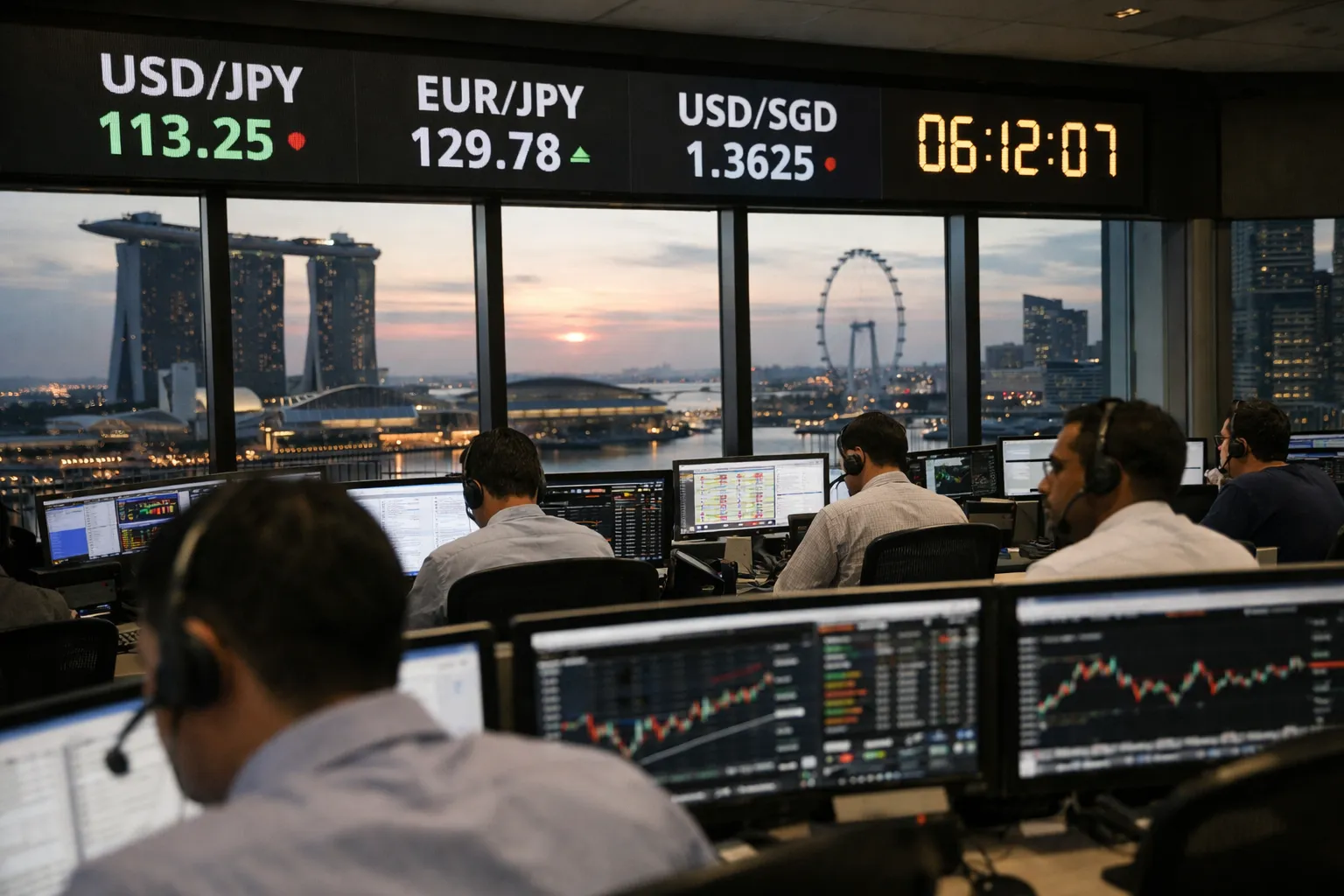
Several leading FX dealers have this month begun routing a larger proportion of their Asian hours liquidity through Singapore-based venues and matching engines, a move that trading desks and prime brokers say is reshaping intraday spreads and client execution patterns across Asian and London overlaps.
What dealers are changing — and why it matters
Market participants describe the shift as a coordinated, gradual reallocation rather than a single-network migration. Desks report increasing the share of electronic limit and request‑for‑stream (RFS) flow that they quote from Singapore-hosted infrastructure during the 00:00–08:00 GMT trading window, while maintaining order-book presence in Tokyo and Hong Kong for certain local flows.
Traders cite three main drivers:
- Operational resilience: Singapore venues are seen by some firms as offering more standardized disaster‑recovery and cross‑border connectivity options, reducing the chance of bilateral routing failures during volatile Asian sessions.
- Clearing and settlement friction reduction: Firms report easier collateral management when settling in SGD and certain regional currencies via Singapore-based custodial arrangements, which lowers intraday funding uncertainty for market-makers.
- Client demand and product mix: Hedge funds and systematic liquidity takers active in Asian hours have pushed for deeper continuous-book liquidity and lower latency matching for algorithmic execution; dealers responding to that demand are centralizing some order-matching in Singapore.
Immediate market impacts
The change has produced measurable effects for active FX traders during the Asian session. Several high-frequency and quant desks told Forex Trading Daily they observed:
- Tighter two-way spreads in major crosses such as USD/SGD and SGD/JPY during the Singapore-centric window, as liquidity depth consolidated.
- Occasional thinning of liquidity on non-deliverable forwards (NDFs) for smaller Asian currency pairs when desks prioritize venue capacity for deliverable spot flow.
- A small increase in mid‑market fragmentation between Tokyo- and Singapore-quoted prices for EUR/JPY and USD/JPY, leading to fleeting arbitrage opportunities that sophisticated market-makers can exploit.
Prime brokers and ex‑dealing venue providers confirm that routing rules in many firms have been adjusted to prefer Singapore-hosted warehouses for client-notified streaming tiers. That has altered which liquidity provider quotes are aggregated into certain retail and institutional platforms during specific hours.
Who benefits — and who bears risk
Hedge funds and buy‑side algos that can access Singapore liquidity directly or through consolidated prime‑broker hubs stand to benefit from more consistent depth and narrower execution slippage in the early Asian window. Conversely, smaller retail brokers and local Asia‑focused banks that lack direct connectivity or capacity to re-host their matching engines may face higher cross‑venue latency and potentially wider spreads for their clients.
Risk managers flag two operational tensions. First, concentration risk: a higher share of regional flow passing through a single city increases systemic exposure to localized outages. Second, regulatory complexity: traders that routinely route to multiple jurisdictions now need to reconcile differing reporting, best‑execution frameworks and record‑keeping standards across Singapore, Japan and Hong Kong.
Regulatory and custody considerations
Industry participants point out that Singapore’s custody and banking network has expanded connectivity with Southeast Asian payment rails in recent years, reducing friction for FX settlement in local currencies. This makes Singapore more attractive as a hub for multi-currency netting and intra-day collateral optimisation.
At the same time, market operators stress that routing changes do not mean a wholesale regulatory shift: desks remain subject to whatever execution and reporting regimes apply in their principal regulatory home. Traders we spoke with emphasized the distinction between commercial venue preference and regulatory domicile for compliance obligations.
Practical implications for traders
For forex‑trading enthusiasts and professional intraday traders, the reallocation of Asian liquidity to Singapore has three practical consequences:
- Watch venue timestamps: Execution timestamps and venue tags may change for existing order strategies — backtests that assume Tokyo‑based spreads may overstate execution costs during Singapore-biased hours.
- Adjust connectivity plans: If you access liquidity through an aggregator or small broker, confirm whether they’ve rerouted to Singapore and whether your latency and order‑acknowledgement pathways are impacted.
- Review funding and margin timing: Intraday funding for settlement may now require tight synchronization with Singapore banking cutoffs; allocate collateral windows accordingly to avoid margin squeezes during overlap hours with London.
Market outlook
The routing change is unlikely to be a one‑time event. Traders expect a continued gradual centralization of certain types of Asian hours electronic spot flow in Singapore, balanced by persistent local liquidity provision in Tokyo and Hong Kong for region-specific trading. Dealers say they will keep a multivenue approach: leveraging Singapore for consolidated streaming and limit depth while maintaining localized presence where client needs demand.
For FX traders, the main takeaway is practical: monitor venue tags on fills, validate latency and slippage assumptions in live trading against the new routing patterns, and coordinate with prime brokers on any margin and custody timing changes. Dealers are positioning for efficiency gains, but that also shifts some operational responsibilities back onto clients who must adapt their connectivity and risk frameworks.
As liquidity patterns continue to evolve, Forex Trading Daily will track execution statistics and publish comparative spreads and venue‑quality metrics in our next market‑structure brief.