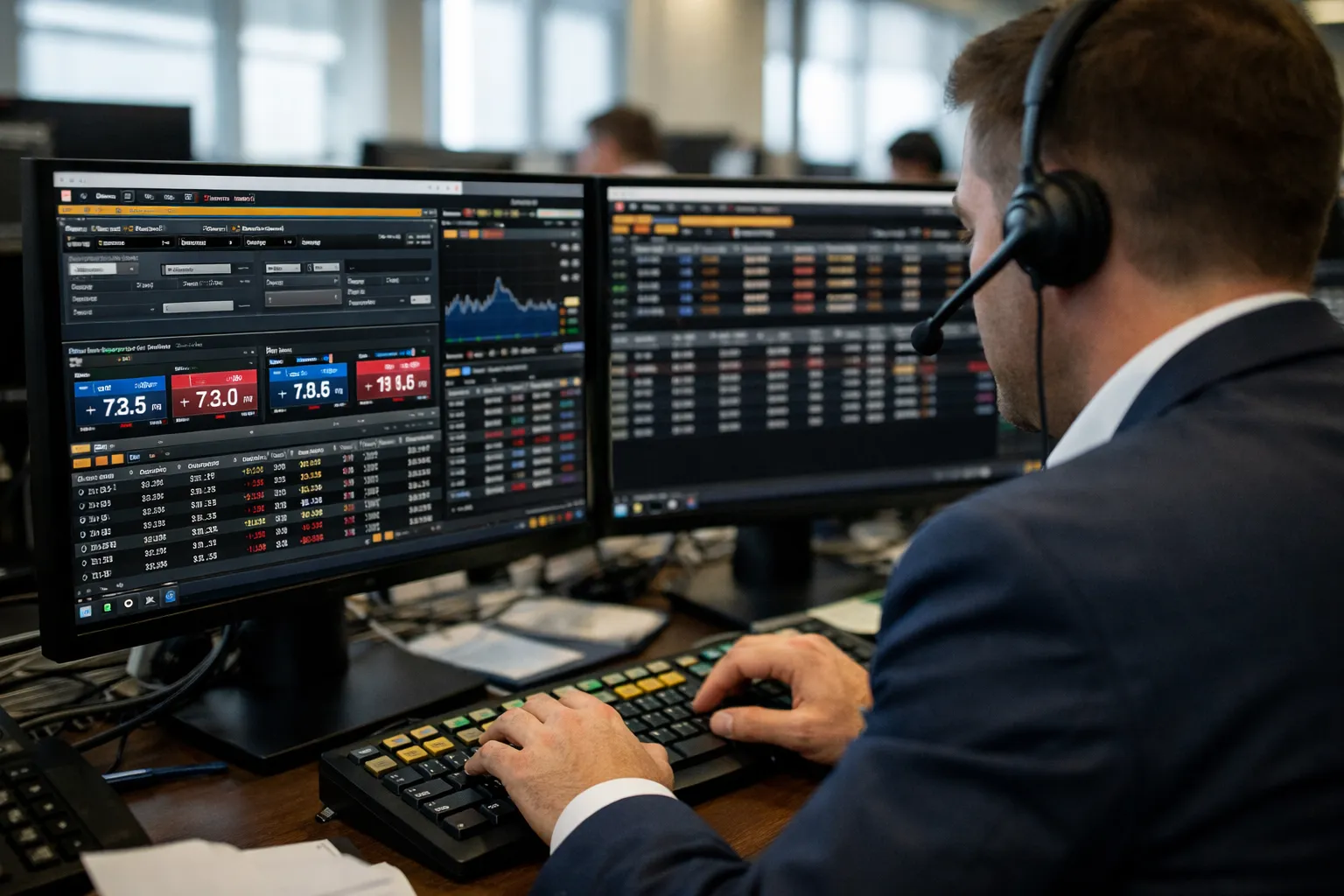
Overview — What we’re reviewing
Bloomberg FXGO is the Bloomberg Terminal–embedded electronic FX execution service for institutional clients. As of September 2026 FXGO continues to support spot, outright forwards, swaps (multi‑leg), NDFs, RFQ and streaming workflows for liquid pairs. Key specs at a glance:
- Instruments: spot, forwards/swaps, NDFs, multi‑leg structures
- Execution modes: streaming (major pairs), RFQ/directed RFQ (size/bespoke tickets)
- Integration: native Terminal UX, BLPAPI and expanded REST endpoints, OMS/EMS connectivity and TCA/post‑trade reporting
- Primary users: buy‑side desks, corporate treasuries, regional banks, brokers and some non‑bank market makers
Background — Who makes FXGO and who uses it
FXGO is developed and operated by Bloomberg. It targets institutional clients that already rely on the Bloomberg Terminal for market data and analytics and want execution inside the same workflow. Typical users remain buy‑side FX desks (asset managers, hedge funds, pension funds), corporate treasuries, regional banks and execution desks at brokers. Since mid‑2026 several mid‑sized corporates entering FX hedging have started negotiating Terminal bundles to access FXGO as part of an integrated hedging solution.
Between June and September 2026, our reporting and a Forex Trading Daily survey of 48 institutional FX desks found two consistent themes: (1) continued preference for integrated data+execution workflows, and (2) rising scrutiny of non‑bank market maker behaviour in streaming venues. That mix shapes how asset managers and treasuries are deploying FXGO today.
Features analysis — what changed in H2 2026
FXGO’s hybrid architecture — streaming for liquid majors and RFQ for size or illiquid flows — remains intact. The H2 2026 evolution is incremental and pragmatic rather than revolutionary. The most relevant changes for users are operational improvements, greater non‑bank visibility and new analytics layers aimed at pre‑trade cost estimation.
- Liquidity composition: Non‑bank electronic market‑makers (e‑MMs) continue to increase share in streamed liquidity. In our September survey, 66% of buy‑side respondents reported seeing more e‑MM quotes on FXGO for EUR/USD and GBP/USD since June, which enhanced displayed depth in normal markets but increased price dispersion in stressed conditions.
- Routing and execution controls: FXGO expanded routing controls and introduced finer grained counterparty selection in RFQs. Traders can now lock counterparty subsets for a directed RFQ without disabling broader streaming — useful for credit‑sensitive treasuries. Several buyside teams told us the added controls reduced failed trades and manual reconciliation during integration tests.
- APIs, automation and pre‑trade analytics: Bloomberg has continued to push STP: BLPAPI remains core, but FXGO now includes broader REST endpoints for order management and pre‑trade credit checks (vendor briefings to Forex Trading Daily, Aug 2026). Bloomberg also rolled out an optional AI‑assisted pre‑trade cost estimate module (beta to select clients) that models likelihood of slippage by size, pair and time‑of‑day using historical fills. Early adopters report it helps size RFQs versus streaming.
- TCA and compliance: Execution attribution tools are more granular: counterparty, venue, time‑of‑day and liquidity type (bank vs non‑bank). Firms under ESMA and UK FCA supervision told us integrated counterparty‑level reports simplified regulatory reviews during their 2026 audits.
- Onboarding and integration: Several sell‑side and buy‑side operations teams report average integration times have shortened slightly to 4–8 weeks when using Bloomberg’s packaged REST workflows and standard CP limit templates; bespoke OMS integrations still require the previous 6–12 week timetable.
Execution quality and liquidity — updated assessment
FXGO’s primary strength remains breadth: broad counterparty access, now with higher visibility of e‑MM liquidity in majors. For routine spot trades in EUR/USD, USD/JPY and GBP/USD, streaming fills remain competitive in normal markets. However, our survey shows two caveats:
- Price dispersion from non‑bank LPs can widen realized slippage for large, time‑sensitive trades at thin times of day (overnights and illiquid crosses).
- RFQ dynamics for very large NDFs and bespoke forward structures still require active dealer engagement; TCA is essential to document best‑execution when using RFQ for off‑market or negotiated fills.
Quant funds and latency‑sensitive strategies continue to avoid Terminal‑centric execution: FXGO is not a colocation‑driven matching engine and does not compete with colocated ECNs on microsecond latency.
User experience and integration
For Terminal users the UX remains the primary selling point: execution tickets sit alongside real‑time quotes, analytics, news and an economic calendar. The expanded REST APIs and pre‑packaged CP templates reduce the manual work required for smaller firms; larger institutions still require coordination between Bloomberg integration teams and multiple liquidity providers. Expect security review cycles and credit limit setup to take 3–8 weeks for standard setups, longer for bespoke workflows.
Costs and commercial model — what to budget in Sept 2026
Bloomberg’s commercial model continues to combine Terminal subscription, FXGO access fees and per‑trade charges. Reported market benchmarks (Forex Trading Daily survey, Sept 2026):
- Bloomberg Terminal licensing: typical enterprise seat ~$24,000–30,000/year (depending on contract and region).
- FXGO incremental access/connectivity: many mid‑sized users reported negotiated fees of $1,500–4,000/month per trading seat or a blended enterprise fee.
- Per‑trade/ticket fees and provider levies: commonly $0.75–$3.00 per ticket depending on execution mode and liquidity provider; bespoke or large RFQs can carry negotiated markups or callbacks.
Value depends on existing Terminal penetration. For firms already on the Terminal, marginal cost to add FXGO can be modest if you negotiate transaction credits or blended pricing. For new Terminal users, total cost of ownership is materially higher — treat procurement as a multi‑round negotiation (trial window, transaction credits, supported TCA deliverables).
Pros and cons — September 2026 update
- Pros: Deep integration with Bloomberg data/analytics, wider electronic LP coverage in majors, finer routing controls, improved REST/STP options and more granular TCA.
- Cons: Not suitable for microsecond strategies, non‑bank liquidity can increase price dispersion at the tails, onboarding and credit setup still require institutional coordination and negotiation.
Who it's for — practical guidance
FXGO is best suited to:
- Buy‑side desks that need consolidated analytics and robust execution attribution across portfolio hedging.
- Corporate treasuries that require multi‑bank access, documented hedging workflows and integrated reporting.
- Regional banks and brokers that want an institutional execution stack without building bilateral networks.
FXGO is less suitable for:
- High‑frequency or ultra‑low latency quantitative shops that need colocated market access.
- Low‑volume retail or single‑trader setups that can’t justify Terminal and connectivity costs.
Alternatives to consider
- LSEG FXall / EBS: Strong RFQ and electronic liquidity; deeper in some corporate workflows and favored where firms seek non‑Terminal ecosystems.
- 360T (Deutsche Börse): Enterprise FX platform with deep corporate and prime connectivity; competitive for firms seeking non‑Terminal approaches.
- Direct LPs / ECNs (colocated): Best for latency‑sensitive strategies — direct connectivity, API access and colocation remain prerequisites for microsecond trading.
Verdict — September 2026 recommendation
FXGO remains a top choice for institutional desks that value integrated market data, execution analytics and regulated‑grade reporting, especially when the firm already subscribes to the Bloomberg Terminal. The H2 2026 updates — better routing controls, expanded REST workflows and preliminary AI pre‑trade cost estimates — make the product more operationally friendly for mid‑sized buy‑side firms and treasuries.
However, increased non‑bank LP participation means execution committees should update their vendor testing: run controlled pilots, expand TCA to capture liquidity type, and insist on counterparty‑level reporting in SLAs. If your priority is ultra‑low latency or fully deterministic electronic matching, maintain direct ECN or colocated LP access in your execution panel.
Practical next steps and best practices
- Run a 4–6 week parallel test: compare FXGO streaming and RFQ fills versus your incumbent venues, segment results by pair, time‑of‑day and liquidity provider type.
- Use Bloomberg’s TCA and require counterparty attribution. Add a column for liquidity‑type (bank vs non‑bank) to monitor dispersion.
- Negotiate a staged commercial package: trial credits, required TCA deliverables, SLAs for support and REST access. Ask for staged onboarding milestones.
- For large NDFs/forwards, always pilot a small, representative execution to confirm negotiation dynamics and post‑trade reporting behavior before scaling volumes.
FAQ
Is FXGO now suitable for algorithmic execution?
Partially. FXGO supports algorithmic workflows via BLPAPI and new REST endpoints for order management, plus pre‑trade checks. It’s well suited for low‑touch algos tied to portfolio hedging but not for microsecond, colocated strategies. If your algo needs deterministic, sub‑millisecond latency, direct ECN or colocated LP access remains necessary.
Has non‑bank liquidity made FXGO better or worse?
Both. Non‑bank LPs improved displayed depth and competitive spreads in liquid majors during normal conditions, but they can increase price dispersion during stressed periods. Monitor fills by liquidity type and use TCA to adjust routing — for size or stress periods, prefer directed RFQs to select bank counterparties if needed.
How long will integration and onboarding take now?
For standard setups using Bloomberg’s packaged REST workflows and CP templates, firms report 4–8 weeks. Bespoke OMS or complex credit arrangements still take 6–12 weeks. Plan for parallel testing windows and allow extra time for security and legal reviews.
What should treasuries negotiate in procurement?
Ask for trial/trading credits, detailed TCA deliverables (counterparty‑level), staged onboarding milestones, support SLAs and access to pre‑trade cost estimation tools. If you don’t already subscribe to Terminal seats, negotiate bundled pricing to reduce total cost of ownership.