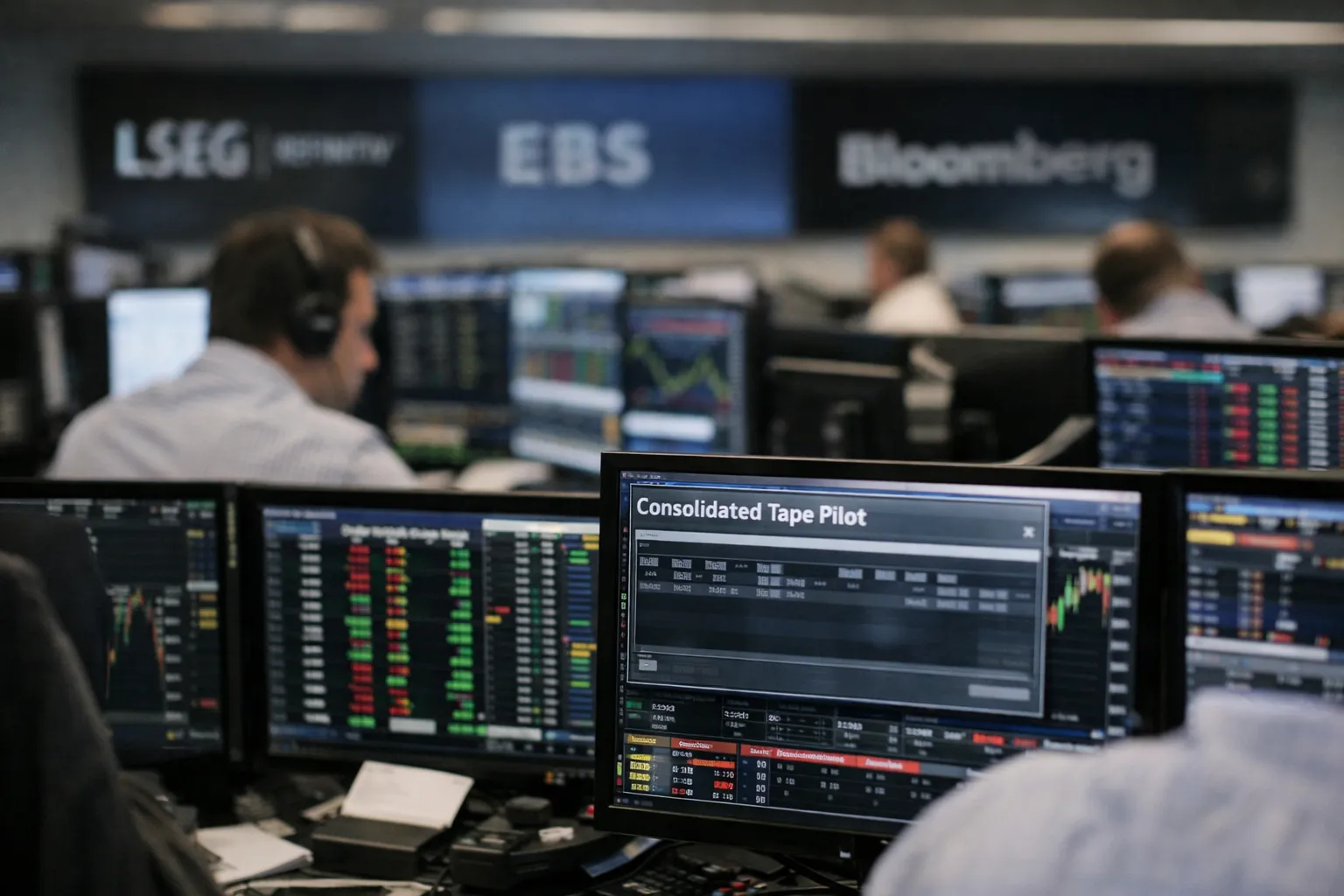
Who: a consortium of venue operators, bank dealers and market‑data vendors including LSEG/Refinitiv, Cboe's EBS, Deutsche Börse's 360T, Bloomberg and LMAX, together with a cohort of tier‑one banks and prime brokers. What: an industry‑led pilot to deliver a consolidated pre‑trade FX tape that aggregates order‑book depth, time‑stamped order events and standardized market data. When: announced in late April 2026; Phase 1 testing ran through June and the pilot entered its July 2026 public update phase. Where: technically distributed via cross‑connects and cloud channels serving primary trading hubs in London, New York and Singapore. Why: to reduce liquidity fragmentation, improve best‑execution evidence, and provide normalized depth for algos and execution analytics.
Context: why this matters now
The FX market remains the largest and most fragmented OTC market: global FX average daily turnover exceeded $7 trillion in recent years, concentrated in G10 pairs but increasingly active in liquid EM crosses outside London/New York hours. Institutional buy‑sides and algo vendors have pressed for a consolidated pre‑trade view to reduce blind spots when routing large orders and calibrating smart order routers (SORs). Unlike consolidated best‑bid/offer (CBBO) feeds, the pilot aims to deliver aggregated depth at standardized price increments and normalized timestamps so liquidity can be compared across venues in a latency‑aware way.
Phase 1 findings and technical progress (July 2026)
- Scope validated. Pilot organizers report Phase 1 successfully validated the core data model and message schema across participating venues for the initial set of six G10 pairs (EUR/USD, USD/JPY, GBP/USD, USD/CHF, AUD/USD, USD/CAD).
- Clock sync and timestamps. Participants confirmed sub‑microsecond synchronization using a hybrid GNSS + Precision Time Protocol (PTP) approach; the group flagged jitter reduction as a remaining focus for Phase 2.
- Depth normalization. The consortium adopted 1‑pip buckets for major G10 pairs and 0.1‑pip resolution for EUR/USD where needed, with aggregated depth reported at standardized price levels and an event stream of order add/cancel trades.
- Distribution models tested. Phase 1 included both direct cross‑connect delivery for ultra‑low latency consumers and cloud‑native delivery (AWS/GCP) aimed at the buy side and analytics providers. Organizers highlighted predictable cloud latency but noted higher variability than direct feeds under stress testing.
- Anonymization controls. The pilot implemented configurable anonymization thresholds and delayed microsecond reporting modes for designated liquidity providers to mitigate commercial‑sensitivity concerns.
How Phase 1 changes the technical and commercial debate
Phase 1 became a practical test of longstanding theoretical trade‑offs: how much pre‑trade transparency is useful before it erodes display liquidity, and how to deliver normalized depth without imposing prohibitive costs. The pilot’s layered approach — low‑latency direct feeds plus cloud distribution and tiered anonymization — reflects a compromise: ultra‑fast consumers will still pay for direct access; most buy‑side firms can use cloud delivery for analytics and compliance.
Commercial terms remain under negotiation. Organizers told participants they are exploring tiered pricing: a high‑throughput, low‑latency tier for brokers and HFTs, and an affordable cloud subscription tier for asset managers and smaller hedge funds. That mirrors discussions in equity consolidated‑tape programs but is tailored to FX’s OTC topology.
Practical implications for traders (what to do now)
- Audit algos and SORs. Start testing your execution logic against normalized depth buckets rather than venue snapshots. Back‑tests using Phase 1 sample files or cloud sandboxes (where available) should be prioritized before Phase 2 expands coverage.
- Revisit latency assumptions. Expect cloud‑delivered consolidated depth to exhibit higher median latency but lower cost; reserve direct feeds for latency‑sensitive strategies.
- Document best execution. Use consolidated depth as an additional source of evidence — but continue to preserve venue‑level logs. Regulators will expect demonstrable decision rules, not just consolidated snapshots.
- Engage in governance. Institutional firms should nominate representatives to governance and technical working groups; Phase 2 will require more buy‑side input on anonymization thresholds and commercial terms.
Impact and who is affected
Buy‑side firms seeking better best‑execution documentation and execution algos stand to gain most from a usable consolidated pre‑trade tape. Electronic market makers and proprietary trading firms will watch anonymization policy closely: if thresholds are too permissive, displayed liquidity could compress; if too restrictive, the tape may not materially improve price discovery. Vendors and cloud providers have a commercial opportunity to bundle tape delivery with analytics and algo suites.
Reactions from the market
Participants who briefed industry press in July noted cautious optimism. A technology lead at one participating exchange said the pilot “demonstrated feasibility for standardized depth across venues,” while buy‑side heads we spoke with emphasized the need for clear commercial terms and governance before broad adoption. Regulatory observers in the EU and UK continue to monitor the initiative; the Financial Conduct Authority (FCA) and European Securities and Markets Authority (ESMA) have previously signaled interest in data consolidation for market structure reviews, and industry participants expect regulators to review the pilot’s post‑Phase 2 report.
Operational and regulatory considerations
The pilot’s governance group published a draft operations playbook in June that outlines data quality KPIs, incident reporting, and an appeals process for anonymization decisions. Organizers are also preparing a post‑pilot metrics dashboard covering latency, coverage, and observed changes in displayed liquidity and spread dynamics to be published after Phase 2 testing.
What’s next — timeline and watch‑points
- Q3 2026 (July–Sept): Phase 1 transition work — broadened simulated stress tests, refinement of anonymization rules, and initial commercial term proposals circulated to stakeholders.
- Q4 2026: Phase 2 aims to expand coverage to additional G10 pairs, pilot limited EM crosses, onboard more market‑makers and begin live‑parallel runs with end users under subscription pilots.
- Post‑pilot: Organizers plan a post‑pilot report in late Q4 2026 or early Q1 2027 with KPIs on latency, coverage, and market‑microstructure effects. Regulatory review and potential market adoption decisions are expected thereafter.
For FX traders, the message in July 2026 is active preparation: test algorithms on normalized depth, decide which delivery tier fits your strategy, engage with governance to shape anonymization limits, and budget for a multi‑vendor data stack if you plan to use the tape in production.
How will the tape affect spreads and displayed liquidity?
The tape does not by itself change how venues match orders; Phase 1 showed that consolidated visibility can alter participant behavior. If anonymization thresholds are low, some providers may reduce displayed size to avoid predation, which could widen actionable spreads. If thresholds are pragmatic, the tape should improve cross‑venue price discovery and reduce slippage for large, well‑routed orders.
What are reasonable expectations for latency?
Expect a spectrum: direct cross‑connect delivery (nanoseconds to low microseconds) for latency‑sensitive firms; cloud delivery with slightly higher and more stable latencies for analytics and compliance. The pilot is aiming to minimize jitter and publish KPIs so users can select the appropriate tier.
How should buy‑side firms prepare commercially?
Budget for at least two data tiers, review vendor SLAs closely, and retain venue‑level logs for compliance. Engage in governance working groups to influence anonymization policy and commercial pricing during Phase 2.
Is the pilot endorsement regulatory pressure?
No. The pilot remains industry‑led and voluntary. Still, participants expect regulatory interest in the outcomes because consolidated pre‑trade transparency intersects with best‑execution and market‑structure oversight in the EU and UK.