
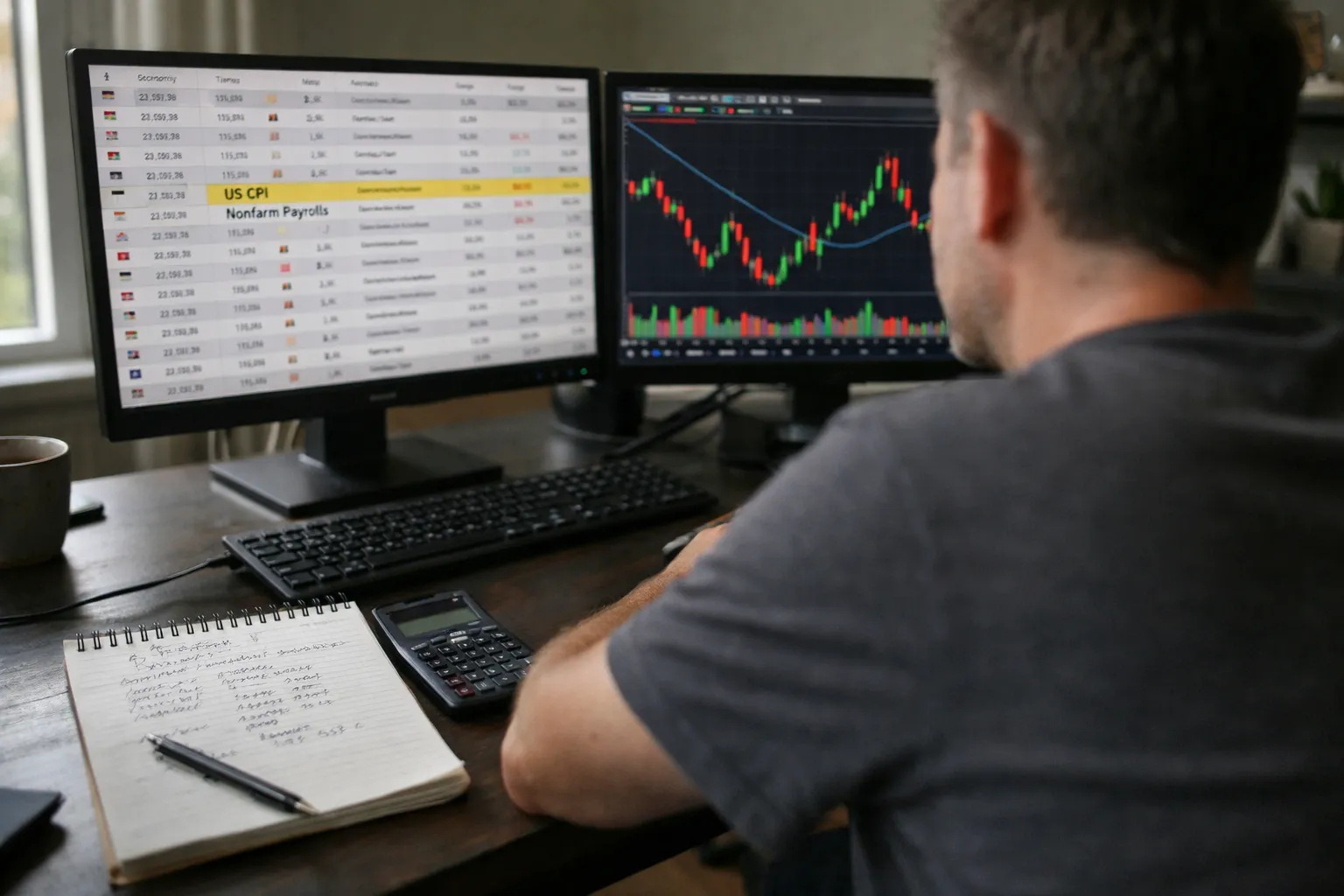
What you'll learn: how to build a repeatable, execution-aware CPI and NFP trading plan for July 2026. This guide updates the April 2026 framework with new market microstructure realities, trading examples, and actionable checks you can use right now.
Who this is for: discretionary retail and semi-pro FX traders who trade U.S. macro prints and want a rules-based, risk-conscious approach that accounts for today’s liquidity and venue fragmentation.
The numbers tell a different story when venue spreads normalize in a minute instead of a second, retail execution analytics are widely available, and low-latency market-making has both improved and fragmented liquidity. Read on for concrete steps, sizing examples, an updated checklist, and the new hedging and execution methods I’ve been using in my trade logs through H1–2026.
Prerequisites / Context: What to know before trading CPI/NFP (July 2026)
1) What CPI and NFP still move in FX — and what’s changed
- CPI: continues to reprice the expected path of policy rates and real yields. Core measures still draw the strongest near-term market responses; headline vs. core differences cause intra-release whipsaws.
- NFP: remains a composite signal—jobs, unemployment rate, and average hourly earnings (AHE). Wage components and revisions now frequently dictate whether an initial DXY move persists or reverses.
- New to 2026: positioning sensitivity is higher. Because algorithmic liquidity providers adjust quote depth faster, modest surprises can be amplified when market positioning is crowded—making pre-release priced-in expectations and positioning checks more important than ever.
2) Use market pricing and execution data, not your macro gut
Your first job when trading a release is to measure what the market already expects and where liquidity sits.
- Fed pricing: CME FedWatch and short-dated OIS futures remain the best immediate signals for policy expectations. Watch for intra-hour shifts in implied odds; those matter more than headlines in the first 60 minutes.
- Front-end yields: 2y moves are the fastest observable proxy of a policy surprise; use real-time yield feeds or Treasury futures for confirmation.
- Execution analytics: July 2026 brings broader retail access to fills data (average spread/slippage per broker per release). If your broker publishes a monthly news-time slippage metric, use it to calibrate sizing and method choice.
3) Microstructure reality in mid‑2026 — the key consequences
Two structural forces that matter:
- Faster, fragmented quoting: major ECNs and proprietary liquidity providers quote and withdraw in milliseconds. Spreads can widen sharply and normalize quickly, but the first 3–10 seconds remain noisy.
- Broker and venue divergence: retail execution quality shows wider variance. Some ECN-style brokers now deliver sub-1-pip effective news-time spreads more reliably; others still show 3–8+ pips and large one-off slippage.
Plan for:
- Spread widening: majors typically widen to 2–6 pips in the first 10–30 seconds in many retail venues; weaker venues show larger, longer-lasting spikes.
- Slippage and fills: stops often fill several pips away in the immediate seconds; market orders can suffer outsized fills on cross and exotic pairs.
- Whipsaws: rapid algorithmic repricing produces fast reversals once the full release (components and revisions) is parsed.
Step 1: Define a “meaningful surprise” threshold (and calibrate it)
- List consensus and components: write down consensus for core & headline CPI (m/m and y/y) and for NFP components (headline jobs, unemployment rate, AHE). Include revision risk.
- Translate to rate impact: use FedWatch + 2y yield sensitivity to set how large a surprise must be to move policy odds materially. If a 2y move of 5–10 bps historically correlates with a 30–50 pip DXY move in the first hour, use that as your calibration band.
- Set numeric surprise bands: keep them simple and repeatable for each component — e.g., CPI core m/m: Soft ≤ 0.1%, In-line 0.2%, Hot ≥ 0.3%. For NFP, require compound surprises (jobs + AHE) to classify as “hot” — e.g., jobs +50k and AHE ≥ +0.3% as a working threshold.
Why this matters: markets react to surprises relative to expectations and to the vulnerability of positioning. If front-end rates are already near a policy inflection, the same numerical surprise can have a larger FX impact.
Step 2: Choose the pair(s) — justify by liquidity and execution
Base your pair selection on three objective things: liquidity around releases, your broker’s news-time fill history, and how the pair historically reacts to policy vs. growth surprises.
Practical choices in July 2026
- EUR/USD: still the default for many because of depth and faster spread normalization on the largest ECNs. Use it if your broker’s average news-time spread is under ~1.5–2 pips.
- USD/JPY: offers strong directional moves on rate surprises; watch for stepped repricing and gapping in periods of JPY intervention chatter.
- GBP/USD: liquid but carries event overlap (UK releases) risk—avoid if UK data or BoE events cluster with the U.S. print.
Operational rule: if your broker’s typical live-release EUR/USD spread exceeds ~3 pips, avoid first-minute momentum trades and prefer post-structure or hedged methods (see Step 4).
Step 3: Build a 3-scenario playbook (hot / in-line / soft)
Write a decision tree before the print. For each scenario specify pair, entry trigger, confirmation filters, stop, take-profit, and maximum time-on-trade.
- Hot print: plan USD-positive entries only if both price and front-end yields confirm and spreads collapse near your pre-release tolerance. Consider a smaller initial size and add on confirmed continuation.
- In-line print: expect mean reversion. Either stand aside or use a fast range-reversion rule with strict time stops and reduced size (50–75% of normal news size).
- Soft print: mirror the hot scenario for USD weakness, again requiring yield and spread confirmation before committing full size.
Required data-confirmation filters:
- Yield confirmation: 2y Treasury or short-dated futures move aligns with FX direction inside 60–120 seconds.
- Spread normalization: EUR/USD near your normal all-in spread (e.g., under ~1.5 pips for ECN-like brokers) before entering impulsive trades.
- Price structure: favor a 1–5 minute candle close beyond a key level or a clear break-and-retest rather than the first tick.
Step 4: Pick an execution method that matches your risk tolerance (2026 update)
New practical options have emerged; match method to your venue and documented fills.
Method A: First-minute momentum (high execution risk)
- Mechanic: immediate market exposure in the surprise direction.
- Fit: only if you have documented, repeatable live news fills and automated order handling. Use small initial size and OCO exit tiers.
Method B: Break-and-retest (more stable)
- Mechanic: wait for a clear break, then enter on a normalized-spread pullback.
- Fit: most discretionary traders; best when your broker shows consistent post-spike normalization.
Method C: Post-release range fade (requires discipline)
- Mechanic: fade an overextended in-line move back to pre-release range with strict invalidation.
- Fit: mean-reversion traders with tight time stops (30–60 minutes).
Method D: Wait-for-structure + micro-hedge (new practical hybrid)
- Mechanic: wait 5–30 minutes until structure forms; enter with a smaller spot position and hedge directional exposure with a correlated short-dated futures contract or a mini-swap where available.
- Why it helps: hedging reduces execution noise while you trade the directional structure; hedges can materially lower realized volatility of the trade.
- Fit: multi-venue or institutional-style retail accounts with access to futures or short-dated OTC swaps. Requires monitoring basis and hedging costs.
Method E: Conditional limit ladders (automation-safe in 2026)
- Mechanic: pre-place a ladder of limit and stop-limit orders tied to time and spread conditions (e.g., only activate if spread X and 2y yields move > Y bps within t seconds).
- Fit: traders with reliable API execution and who want a rules-based, non‑emotional method to trade the first 60 seconds without full market orders.
Step 5: Put numbers on risk — position sizing for spread + slippage
Your real risk = stop distance + expected slippage + spread at entry/exit. Use your historical fills; if you don’t have them, assume conservative defaults based on your venue.
- Account risk per trade: conservative: 0.25%–0.50%; post-release structure trades (with confirmation and normalized spreads): up to ~1.0%.
- Estimate transaction cost: many retail setups should assume 2–5 pips all-in on EUR/USD in the first minute unless their broker’s news metrics are better.
- Convert pips to position size: always base position on the effective stop (stop + expected slippage + spread), not the nominal stop.
Concrete example (updated): $25,000 account, risking 0.50% ($125). Planned stop = 15 pips. Observed news-time costs for your broker: 3 pips spread + 4 pips typical slippage in the first 30 seconds. Effective stop = 15 + 3 + 4 = 22 pips. Position size = $125 / (22 pips * pip dollar value). This reduces size ~30% vs. naive sizing on a 15-pip stop.
Step 6: Release-day checklist (so you don’t improvise)
- T‑60 minutes: confirm release time (DST check), scan for clustered prints in ±60 minutes, check pre-release futures positioning and major option expiries.
- T‑30 minutes: mark technical levels (previous day high/low, Asia/London range), write surprise-band classification and pick Method A–E accordingly.
- T‑10 minutes: reduce platform clutter, cancel unrelated orders, verify margin, and check broker maintenance alerts and published news-time slippage stats.
- T‑1 minute: final method and size, confirm spread tolerance and yield-confirmation thresholds. If using limit ladders, arm conditional triggers now.
- T+1 to T+5 minutes: watch spread normalization and yield alignment. If spreads remain abnormal, do not force entries—either wait for structure or trade smaller size.
- T+15 to T+60 minutes: manage per pre-written rules: partial take-profit, trailing stop, or time stop (30–60 minutes typical). Consider hedging unwind if used.
Common mistakes traders make on CPI and NFP days
- Using normal-day stops on abnormal liquidity: a 10-pip stop can behave like a 25-pip loss during a spike.
- Trading the headline, ignoring the details: headline vs core CPI or jobs vs wages often reverses the initial impulse.
- Overtrading the whipsaw: repeated attempts in the first 10 minutes typically bleed P&L via spread and slippage.
- Relying on demo fills: demo liquidity rarely matches live during fast releases—use live small-size tests to build your metrics.
- Assuming all brokers are equal: execution quality varies; pick venues with demonstrable, published news-time performance or keep a broker fill log.
Pro tips (advanced but practical)
1) Keep a 15- and 60-minute release log
Document the 15- and 60-minute moves for each release and pair. After 20–50 events you’ll see patterns: some releases produce an initial fakeout then a durable move; others consistently fade. Use those patterns to refine surprise bands and method selection.
2) Separate data surprise from positioning surprise
Evaluate whether a market moved because of the data number itself or because positioning was crowded. Watch pre-release trends, sizeable option deltas (where observable), and front-end futures. When positioning is crowded, your required surprise threshold should be wider.
3) Use time stops to avoid “death by chop”
If a post-release trade has not worked within 30–60 minutes, exit. Release-day edges are time-sensitive; lingering positions often become noisy losses.
4) Cap pending-order damage
Pending entries triggered in the first minute should be size-capped (50% typical) and tied to daily loss limits (1.5%–3.0% of equity).
5) Consider micro-hedges with short-dated futures or mini-swaps
When available, short-dated futures provide a practical hedge for directional spot risk while you wait for structure to confirm. Be explicit about basis and funding cost: the hedge reduces realized volatility but introduces carry that must be estimated up-front.
FAQ
Is CPI or NFP better to trade for FX in 2026?
Neither is universally better. CPI tends to reprice policy expectations more directly; NFP creates larger and more frequent whipsaws because jobs, wages and revisions can conflict. Choose the event where your broker’s actual news-time execution data is strongest and where your playbook focuses on the meaningful component (core CPI vs. AHE for NFP).
How long should I wait after a CPI/NFP print before entering?
Many traders improve fills by waiting 1–5 minutes for spreads and quotes to normalize. If spreads are still elevated after 5 minutes, wait longer or reduce size. For durable trend trades, waiting 15–60 minutes often preserves directional edge while materially lowering execution risk.
What’s a reasonable risk per trade on news events in July 2026?
If trading the immediate release, conservative active traders typically use 0.25%–0.50% risk per trade because effective risk is higher due to spread and slippage. If trading post-release structure with normalized execution, some traders use up to ~1.0% risk—only after confirming your broker’s live performance metrics.
Do stop-loss orders protect me from slippage during CPI/NFP?
No. Stops express an exit intent; they do not guarantee a price in fast markets. In high-speed repricing, stops convert to market orders and can fill well beyond the trigger. Size and plan for expected slippage based on your broker's historical news-time fills.
How do I choose a broker or venue for release-day trading?
Choose the broker with transparent, published news-time metrics or one that allows you to collect realistic fills with small live trades. Key metrics: median news-time spread, average slippage on stops, percentage of fills within X pips of stop, and order rejection rate during releases. Your trade log is the final arbiter.
Bottom line: A CPI/NFP plan in July 2026 is still not just “buy USD on hot data.” Build surprise bands, require measurable confirmation (yields + spread normalization), size for the true cost of trading, and use hedges or conditional automation where your venue supports them. The edge today is as much about execution as it is about macro insight.