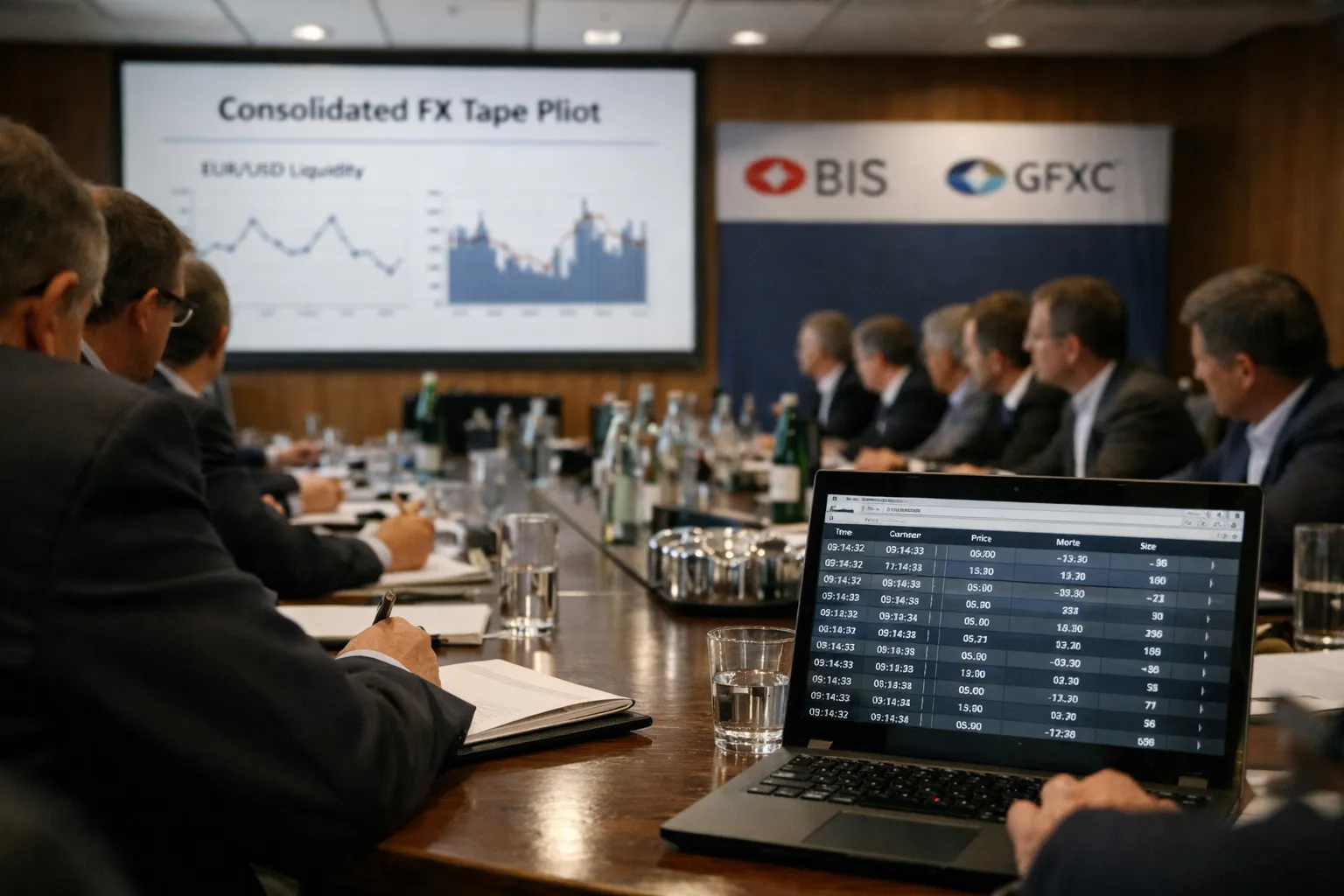
Who, what, when, where, why: The Bank for International Settlements (BIS) and the Global Foreign Exchange Committee (GFXC) are continuing a multi‑phase pilot to build a consolidated trade tape for the global spot FX market. Launched on April 1, 2026, the pilot entered a second implementation phase in June and organisers reported measurable technical progress and broader industry engagement by mid‑July 2026. The aim remains the same: standardize reporting, synchronize timestamps and give supervisors and market participants a unified, actionable view of liquidity and execution quality in major currency pairs.
Context: why this matters now
The FX market is the largest OTC market in the world, with daily spot turnover estimated at roughly $6–7 trillion. Because trading is largely bilateral and fragmented across bank internalization, ECNs, and voice brokers, regulators and execution teams have struggled to measure true market liquidity and venue performance. Equities consolidated tapes have long provided a single source of truth for execution quality; FX lacks that equivalent. The BIS–GFXC pilot aims to change that by testing a neutral feed that normalizes fills, quotes and RFQ events across venues.
What’s new since April 2026
- Expanded participation. Organisers say the pilot’s consenting data contributors grew from an initial cohort of roughly 20 institutions to 34 as of July 15, 2026, including 12 global banks, 6 electronic communication networks (ECNs), 8 brokers/prime‑services venues and a small set of buy‑side firms and market‑data vendors.
- Broader currency coverage. The pilot moved beyond the original focus on EUR/USD, USD/JPY and GBP/USD to include AUD/USD, USD/CAD and EUR/GBP for benchmarking purposes in phase‑2 tests begun June 10, 2026.
- Interim technical metrics. Organisers reported that timestamp synchronization reached sub‑millisecond alignment for 94% of participating feeds during controlled tests on June 28–30, 2026. Peak ingestion rates during stress scenarios exceeded 9 million messages per minute—about 4–5× higher than typical daytime volumes—triggering additional resilience tests.
- Proofs‑of‑concept for data models. Two data schemas (an ISO 20022‑inspired canonical model and a compact JSON variant) were validated in parallel; the steering group will recommend a single standard later in Q3 based on throughput and ease of adoption.
Specific findings and concrete examples
Early analysis from the pilot’s anonymized dataset — restricted to interdealer and brokered spot trades — surfaced three practical insights for execution teams:
- Hidden slippage is measurable. In a May 18, 2026 simulated session that combined ECN and bank internalization feeds, median slippage on aggressive market‑taking in EUR/USD widened by 0.4 basis points relative to venue‑reported prints once off‑venue fills were included.
- Venue fragmentation is more concentrated than assumed. Normalized tape data showed that the top five liquidity providers accounted for roughly 62% of reported interdealer volume in the sample weeks, intensifying scrutiny of internalization’s market‑impact.
- Latency disparities remain material. Despite sub‑millisecond synchronization, end‑to‑end display latency differences between some participants and the tape averaged 10–25 ms, enough to affect high‑frequency flow routing.
Regulatory and industry reaction
National supervisors — including the Bank of England, the Federal Reserve’s market‑stewardship teams and the European Central Bank market‑infrastructure division — have engaged with the steering group informally, according to a BIS statement to participants on July 8, 2026. Several regulators are reported to be watching the pilot closely as they consider whether to adopt standardized reporting in future rule‑making. Commercially, major market‑data vendors have opened preliminary talks to license anonymized tape slices for distribution to buy‑side clients.
"The pilot is proving it's possible to get a single, normalized view without sacrificing participant confidentiality," a GFXC steering‑group member said on condition of anonymity. "But resolving commercial access and fee structures will be the harder negotiation."
Concerns that still need resolving
- Commercial sensitivity. Several banks continue to object to any persistent public disclosure of internalized prices that might reveal client negotiation outcomes; the steering group is testing tiered access plus differential delays (1–10 minutes) to mitigate front‑running risks.
- Cost and operational burden. Smaller ECNs and some buy‑side firms report that the technical cost of normalized feeds, precisely synchronized clocks and secure ingestion pipelines remains a barrier—pilot governance is exploring a subsidy or low‑cost access tier for smaller participants.
- Data governance and dispute resolution. The pilot is drafting a formal audit and redress framework to handle mismatches between venue-reported fills and tape records, expected to be circulated for public comment in August 2026.
Implications for traders and desks — what to do now
Whether you’re a retail quant, prop desk or buy‑side execution team, the pilot’s mid‑2026 results suggest several immediate actions:
- Audit clocks and reconciliation. Confirm your systems can support sub‑millisecond timestamps and reconcile to canonical events; vendors say a clock‑drift check at least every 24 hours is now best practice.
- Engage vendors and venues. Ask execution venues and market‑data providers whether they plan to join the pilot’s public feed or a commercialized tier and when they will support the final schema.
- Recalibrate benchmarks. Expect internal broker scorecards to change. Start back‑testing existing performance metrics against anonymized pilot outputs where available to identify systematic biases from internalization.
- Plan for tiered access. If your firm relies on near‑real‑time benchmarking, budget for paid access levels or negotiate data trials with vendors now—steering‑group members indicate fee models will be piloted in Q3 2026.
What’s next: timeline to watch
- Q3 2026: Steering group to recommend a single data schema and publish a draft governance model (expected August–September).
- Q4 2026: Expanded stress testing with forwards and swaps limited to measurement use cases; simulated public‑access slices to be trialed.
- Q1 2027: Feasibility report and policy recommendations to be shared with national authorities; potential regulatory consultations to follow.
Impact: who stands to gain or lose
Buy‑side execution teams and algorithmic traders stand to gain clearer, more consistent benchmarks for routing decisions and performance measurement. Venues and dealers that rely heavily on internalization may face pressure to justify business models by demonstrating client cost savings. Data vendors see a market opportunity for normalized analytics; smaller venues risk being squeezed unless the pilot’s governance includes affordable participation options.
Reactions
Buy‑side trading heads contacted by this publication welcomed the technical progress but urged caution on access terms. "We want the transparency, but not at the cost of asymmetric data advantages for large vendors," said a head of FX execution at a multi‑asset asset manager in London. A spokesman for a consortium of liquidity providers reiterated the need to protect negotiated client prices and flow confidentiality.
Will this change regulation?
Potentially. Regulators are watching the pilot’s governance choices. If the pilot demonstrates a workable balance between transparency and confidentiality, supervisors could propose mandatory reporting standards modeled on the tape—most likely as part of broader market‑structure reviews rather than immediate rule changes.
FAQ
When will the pilot publish a formal report?
Organisers expect to release a feasibility report and interim recommendations in Q1 2027. The steering group will publish draft governance and schema proposals for consultation in Q3 2026.
Will the tape include client‑level data?
No. The pilot uses hashed and anonymized participant identifiers and is testing tiered access and time‑delays to prevent disclosure of client identities or sensitive negotiated prices.
How can smaller firms participate without high costs?
The steering group is exploring a subsidized or low‑cost access tier and technical onboarding support for smaller ECNs and buy‑side firms; expect details in the Q3 governance paper.
What should trading desks change immediately?
Start by validating timestamping and reconciliation processes, engage vendors about their participation plans, and run back‑tests of execution scorecards against anonymized pilot outputs where available.